This past week ATI21 joined with the Auto Alliance, the Global Automakers and other major trade associations to form the Coalition for Future Mobility.
Together, we’re encouraging Congress to continue its push to introduce legislation critical to accelerating the realization of the immense safety and social benefits of self-driving vehicles.
We’re in for an exciting few weeks. The Senate and House are both poised to introduce landmark legislation critical to ushering in a new era of transportation that will dramatically improve the safe and efficient movement of people and goods. In this era of partisan division, the members of our coalition are united in our encouragement of those members in both houses and on both sides of the aisle in their effort to send a clear message that it is time for America to lead the transformation of mobility.
This should be most welcome news to the public, industry and investors. Since the success of the DARPA Urban Challenge where a number of vehicles powered by sensors, cameras and computers successfully navigated a simulated urban environment, countless innovators from around the globe have been working on developing and combining the technology that will enable self-driving and new mobility models.
Like most recent transformations, there is a global technology race to develop and deploy these technologies as the economic windfall to the firms who get this right are massive. This is not lost on governments, competitors or investors. And while it is recognized that the U.S. invented this capability, global competition to lead the transformation in mobility is keen, cutthroat and coming from unexpected places. While the United States is wrestling with whether to allow such technology on our streets, China and Japan have national plans to move forward with accelerating the deployment of self-driving and Finland, Denmark, United Kingdom, Germany and even the United Arab Emirates are quickly advancing autonomous transportation including automobiles, drones and maritime applications and pioneering the application of new mobility models such as mobility as a service or MaaS.
The potential safety, social and economic consequences of advancing self-driving vehicles are profound. Globally more than 1.3 million people die in vehicle crashes every year and every day in the U.S. 100 people die on our highways and the government says more than 94 percent of those crashes are the result of human error. These are our family members, friends and co-workers. Accelerating the deployment of technologies hold the promise to dramatically reduce fatalities, injuries and the crashes that cost the U.S. economy almost $1 trillion every year.
These innovations also hold the promise to enable more. affordable and convenient transportation options for the disabled, elderly and working poor. When deployed these innovations will allow senior citizens to maintain robust social lives, shop and access health providers even when they can no longer operate a vehicle; the working poor will see shared and affordable door to door transit options replacing their current long, cumbersome and stressful commutes; and the two million working age individuals with disabilities will now have access to much more convenient and affordable transportation options resulting in much fuller and richer lives.
The global economy can benefit immensely by generating new investment in supporting technologies and industries. These technologies will eliminate congestion and delays resulting crashes that result in lost life, debilitating injuries and almost a trillion a year in mostly avoidable economic costs that can be redirected to other more productive investments. We may see reductions in taxes as dramatic reductions in crash-related congestion and new efficiencies created through shared and efficient vehicle use will result in additional capacity from existing infrastructure.
By definition disruptions of this magnitude create uncertainty. We should be mindful that despite some who insist on painting a dystopian view of the future, throughout history these transformations have created opportunity and elevated society. From the stirrup to the internet, modern history is rife with examples of nations embracing innovation flourishing and those who did not sometimes ceased to exist.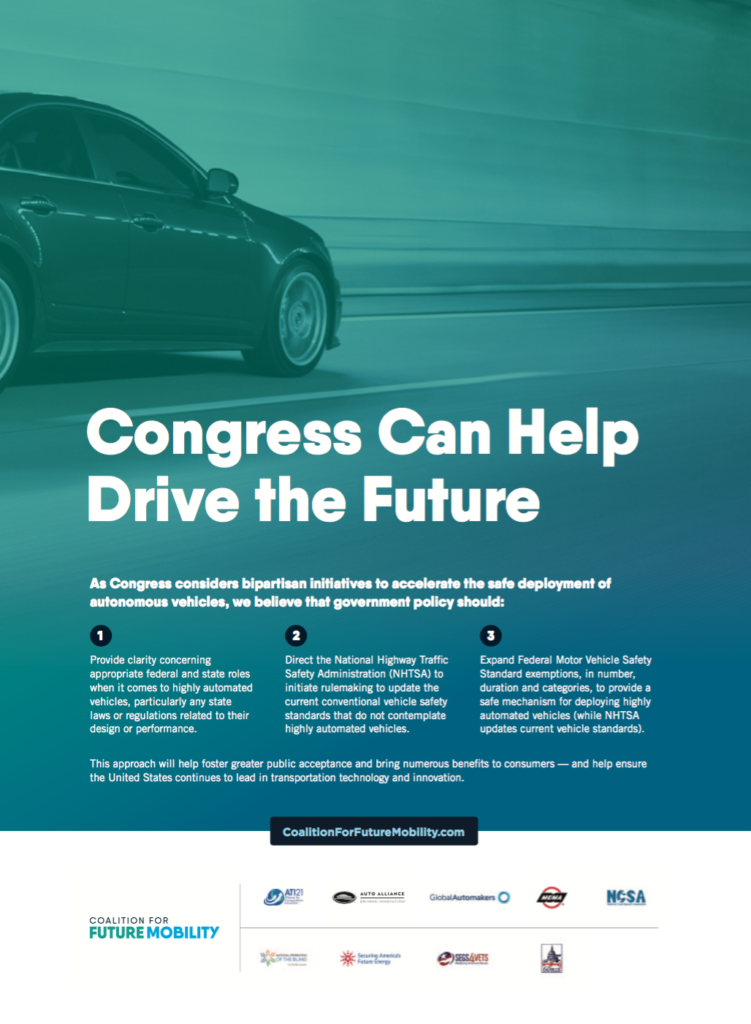
Innovation is America’s DNA and we should not cede the shaping of 21st-century mobility to others. We invented it and Congress should be commended for working together to ensure America continues to lead the World in the development and deployment of innovations that will create the future of mobility.
ATI21 is proud to join the Coalition for Future Mobility to advance America’s leadership in accelerating our path to the future.